
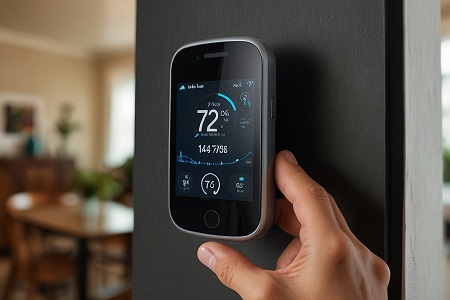
Heating and cooling make up nearly 50% of the average home’s utility costs. That means the single most important device controlling your monthly energy budget isn’t your refrigerator, your water heater, or your lighting—it’s the small box mounted on your hallway wall.
While traditional thermostats require you to manually guess at schedules, modern smart thermostats use automation, data tracking, and proximity sensors to trim the fat from your energy usage. Independent data from ENERGY STAR confirms that installing a certified smart thermostat cuts heating and cooling bills by an average of 8% to 12%, paying for itself in roughly one to two years.
If you are wondering exactly how these high-tech devices convert Wi-Fi connectivity into cold, hard cash, it comes down to five core engineering features.
1. Automated “Setback” Schedules
The U.S. Department of Energy notes that you can save up to 10% a year on HVAC costs by rolling back your thermostat by 7°F to 10°F for eight hours a day.
While old programmable thermostats technically allowed this, studies show that most homeowners found them too frustrating to program or simply forgot to update them when schedules shifted. Smart thermostats eliminate human error:
-
Learning Behavior: Devices like the Google Nest track your manual adjustments during the first week. If you consistently turn down the AC when leaving for work at 8:00 AM and raise it at bedtime, the device builds a customized, dynamic schedule automatically.
-
Algorithmic Adaptability: If you start working from home on Fridays, the thermostat notices the shift in habits and self-corrects the schedule without requiring you to reprogram anything.
2. Geofencing and Occupancy Sensors
One of the biggest waste factors in home energy is heating or cooling an empty house because plans changed. Smart thermostats solve this using two distinct technologies to verify if anyone is actually home:
-
Geofencing: By linking to your smartphone’s GPS via an app, the thermostat establishes a virtual boundary around your property. When your phone crosses that boundary away from home, the system immediately slips into an energy-saving “Away Mode.” When you head back and cross the boundary toward home, it boots back up to your preferred comfort level so the house is perfect when you walk through the door.
-
Proximity & Motion Sensors: Models like the Ecobee use physical motion sensors on the unit (and optional remote sensors placed in other rooms) to detect physical activity. If the house is dead silent for a prolonged period, it automatically scales back HVAC runtime.
3. Beating Time-of-Use Rate Structures
Many utility providers—particularly in high-demand regions like Texas, California, and Arizona—use Time-of-Use (TOU) pricing. Under these plans, electricity prices skyrocket during peak hours (typically late afternoon and early evening) when the electrical grid is under maximum stress.
Smart thermostats can sync directly with your energy provider’s pricing schedule to execute a strategy called pre-cooling or pre-heating:
How it works: The thermostat intentionally runs your HVAC system slightly harder in the morning when electricity rates are at their cheapest. Once the expensive peak-price window hits in the afternoon, the system shuts down or runs at an absolute minimum, relying on the trapped, pre-cooled air to keep you comfortable while avoiding peak-rate charges.
4. Remote Control Prevents “Whoops” Scenarios
We have all experienced the sudden wave of panic that hits 30 minutes into a drive to the airport: “Did I remember to turn down the HVAC before we left?”
With traditional hardware, that mistake costs you a week’s worth of paying to condition an empty home. Wi-Fi connectivity allows you to log into a smartphone app from anywhere in the world to instantly audit your home’s climate, review current runtime, and force the system into an eco-friendly vacation mode.
5. System Health Monitoring and Maintenance Alerts
An inefficient HVAC system is an expensive HVAC system. When components are dirty or failing, the system has to draw significantly more amperage to move the same amount of air.
Smart thermostats act as early-warning diagnostics for your mechanical system by tracking performance metrics over time:
-
Air Filter Reminders: Instead of guessing every few months, smart thermostats measure actual system runtime hours to alert you precisely when your filter is choked with dust and restricting airflow.
-
Short-Cycling Alerts: If your system is turning on and off rapidly—a major efficiency killer that causes premature mechanical failure—the thermostat will flag the anomaly so you can call a technician before a catastrophic breakdown occurs.
-
Energy Audits: Monthly reports break down exactly how long your system ran, how local weather patterns impacted your consumption, and how your household’s efficiency compares to your neighbors.
By taking the guesswork out of temperature management and actively defending your home against peak utility rates, a smart thermostat shifts your HVAC system from a reactive machine into a proactive, cost-cutting asset.
Need Local Help in Dallas?
If you have already gone too long without changing your filter and notice your system is short-cycling, making strange noises, or failing to blow cool air, it’s time to bring in the experts before a minor issue turns into a total system failure.
Dallas Residents: If you live in Dallas, TX, you can easily find a reliable, professional HVAC technician to inspect your system, clear out frozen coils, or handle emergency fixes. Find a local expert right away by visiting hvacrepairdallas.online.
A habit as simple as setting a monthly reminder on your phone to check the air filter can mean the difference between a minor maintenance chore and a massive, unexpected repair bill. Keep your air flowing, keep your system breathing, and keep your hard-earned money in your bank account.
Don´t wait until your HVAC needs maintenance or worse it fails, at HVAC Repair Dallas, we provide with the best HVAC Repair Service Providers in Dallas, TX and nearby areas. Find Yours Now
HVAC Repair Dallas
Other Articles That May Interest You:
10 Warning Signs Your Air Conditioner Is About to Fail
How Often Should You Service Your HVAC System in Dallas?
Why is My AC Blowing Hot Air? Posible Causes You Should Be Aware of
The HVAC Maintenance Checklist Every Dallas Homeowner Should Follow
Why Changing Your HVAC System Air Filter Could Save You Thousands in Repairs
The Most Common HVAC Problems Homeowners Ignore
How to Extend the Life of Your Air Conditioning System by 5+ Years
DIY HVAC Maintenance Tasks You Can Safely Do Yourself
What Happens If You Skip Annual HVAC Maintenance?
Why Is My Electric Bill So High During Dallas Summer?
15 Ways to Reduce Cooling Costs During a Dallas Heatwave
How Smart Thermostats Can Lower Your HVAC Costs

0 Comments